0 item(s)
View cart
You have no items in your shopping cart.
Every low-binding tube on the market makes the same claim. Very few vendors will hand you the data behind it.
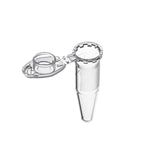
We think "trust us" isn't good enough when your sample is irreplaceable — so here is exactly how we tested our 1.5 mL Low Protein-Binding tube , the numbers we measured, and how those numbers translate into protein you keep.
To quantify how much protein a tube holds onto, you need a protein you can count. We used FITC-labeled bovine serum albumin (BSA-FITC) — a fluorescent model protein — so that the amount of protein remaining in solution can be read directly as a fluorescence signal.
The method, in brief:
A higher recovery means less protein was lost to the tube wall. We ran three products side by side, in triplicate:
CP — Biofargo Low Protein-Binding tube
NC — a standard (untreated) tube
E — a leading competitor's protein low-binding tube
| Protein recovery | 24 hours | 48 hours |
| Biofargo Low-Protein-Binding (CP) | 88.5% | 80.0% |
| Standard tube (NC) | 78.7% | 71.1% |
| Competitor low-binding (E) | 87.8% | 76.7% |
Two things stand out.
1. The low-binding surface clearly works. After 48 hours, the Biofargo tube retained ~80% of the protein in solution versus ~71% for a standard tube — roughly a 9-percentage-point rescue of sample that a standard tube would have lost to its walls. At 24 hours the gap is about 10 points (88.5% vs 78.7%).
2. It performs on par with — even slightly ahead of — the premium competitor. Against a leading brand's protein low-binding tube (E), Biofargo matched it at 24 h and came out marginally ahead at 48 h (80.0% vs 76.7%). Within the assay's variability, the two are equivalent — meaning you're not trading performance for price.
(Full raw fluorescence values, per-replicate data, and recovery curves are in our validation report — see below.)
Anyone can print "low-protein-binding" on a bag. What should actually move your purchasing decision is a vendor that:
That's the whole point of Biofargo: the same validated performance as the premium brands, without paying for the brand name.
Want the full validation report? It includes the complete raw dataset, the recovery curves, and the method in detail. Request the validation report →
Want to see it in your own workflow? We'll send a free sample to test head-to-head against your current tubes. Request a sample →
🛒 Ready to switch?
Order the 1.5 mL Low Protein-Binding SnapLock Tube (Cat# 801168-S) →
Clear polypropylene · rated to 14,000 × g · sterile · validated protein recovery.
Related reading: Why Do Proteins Stick to Plastic Tubes? · Protein Low-Binding vs. DNA Low-Binding Tubes — Which One Do You Need?
 Biofargo Team