0 item(s)
View cart
You have no items in your shopping cart.
For Research Use Only (RUO)
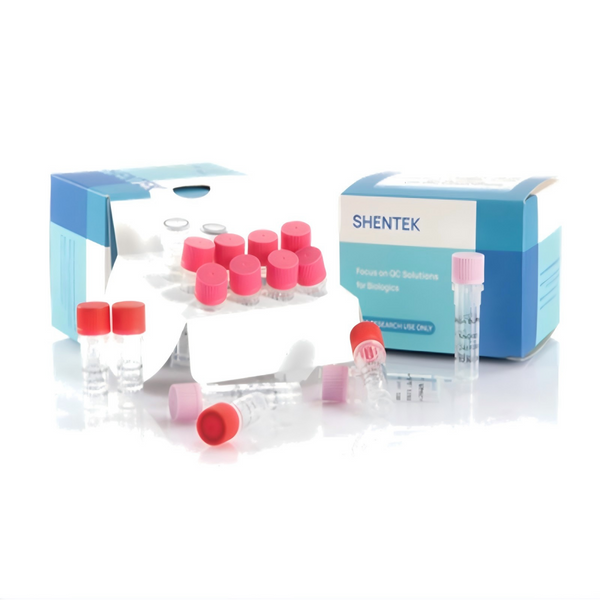
SHENTEK® Residual CHO DNA Size Analysis Kit (2G) is a fluorescent quantitative PCR (FAM) based kit for rapid and specific quantitation of residual Chinese Hamster Ovary (CHO) host cell DNA fragments across multiple size ranges in biopharmaceutical samples (from in-process to final products). The assay amplifies four discrete fragment sizes (95 bp, 110 bp, 215 bp and 523 bp) to produce an accurate size distribution profile. The kit includes primer/probe mixes for each fragment, an internal positive control (IPC), qPCR reaction buffer, CHO DNA control for standard curves and DNA dilution buffer (DDB). The assay sensitivity reaches femtogram (fg) level. Refer to SHENTEK® Residual Host Cell DNA Sample Preparation Kit (Product No. 1104191) for extraction procedures. Product No.: 1103170-2. Reagents sufficient for 4 × 100 reactions.
| Parameter | Details |
|---|---|
| Target fragment sizes | 95 bp, 110 bp, 215 bp, 523 bp |
| Detection chemistry / dyes | Target probes: FAM reporter; IPC: VIC reporter; ROX as passive reference |
| Sensitivity (LOD) | Detection limit reaches femtogram (fg) level |
| Standard curve concentrations (examples) | ST1 = 300 pg/µL; ST2 = 30 pg/µL; ST3 = 3 pg/µL; ST4 = 0.3 pg/µL; ST5 = 0.03 pg/µL (ST0 = 3000 pg/µL stock) |
| Suggested linear range | Approximately 0.03 – 300 pg/µL (based on provided standard curve points) |
| Reaction volume | 30 µL total reaction volume (20 µL qPCR MIX + 10 µL sample/standard) |
| qPCR mix per reaction | qPCR Reaction Buffer 15.9 µL + CHO Primer&Probe MIX (per fragment) 2.8 µL + IPC MIX 1.3 µL = 20 µL |
| Sample input per reaction | 10 µL (standard/ST1–ST5, DDB for NCS, or purified sample) |
| Thermal cycling conditions | Activation: 95 °C 10:00 (1 cycle); Denaturation: 95 °C 00:15; Annealing: 60 °C 00:30; Extension/Read: 72 °C 01:30; 40 cycles. Fluorescence read during extension step. |
| Analysis settings (recommended) | Manual Ct selection; Threshold = 0.02; Automatic baseline; Standard curve (Absolute Quantitation) |
| Assay throughput | Reagents provided for 4 × 100 reactions (kit components support ~400 reactions distributed across four fragment assays) |
• For Research Use Only (RUO) — not for diagnostic use.
• Read Material Safety Data Sheets (MSDS) and follow handling instructions.
• Wear appropriate PPE (protective eyewear, mask, lab coat, gloves).
• Work in DNase-free environment; use DNase-free consumables and low-retention tips to avoid contamination.
• Irradiate workspace, pipettes and tubes with UV for 30 minutes and disinfect with 75% alcohol before use.
• Thaw reagents completely at 2–8 °C or on ice; protect light-sensitive reagents from light.
• Store kit components at –20 °C and check expiration dates. Kit stable up to 24 months under recommended storage.
• Prepare separate standard curves for each fragment length (95, 110, 215, 523 bp). Include at least five standard concentrations.
• If DNA Dilution Buffer (DDB) is cloudy or contains precipitates, heat at 37 °C until clear before use.
• Use NTC (no template control), NCS (negative control sample) and ERC (extraction reference control) as directed to monitor contamination and extraction recovery.
• Mix qPCR reactions thoroughly, seal plate, spin briefly and avoid bubble formation prior to run.
Research Use Only (RUO) – This product is intended for laboratory research purposes only and not for clinical or regulatory diagnostic use.
Not intended for use in USDA or FDA regulated diagnostic testing or official compliance testing.
When can I expect my order to ship?
Most orders are filled and shipped within 2-3 business days from the time they are received.
Our standard shipping usually take 2-5 days.
We also provide express shippping for time-sensitive deliveries.
Email contact@biofargo.com if you have any requirements.