0 item(s)
View cart
You have no items in your shopping cart.
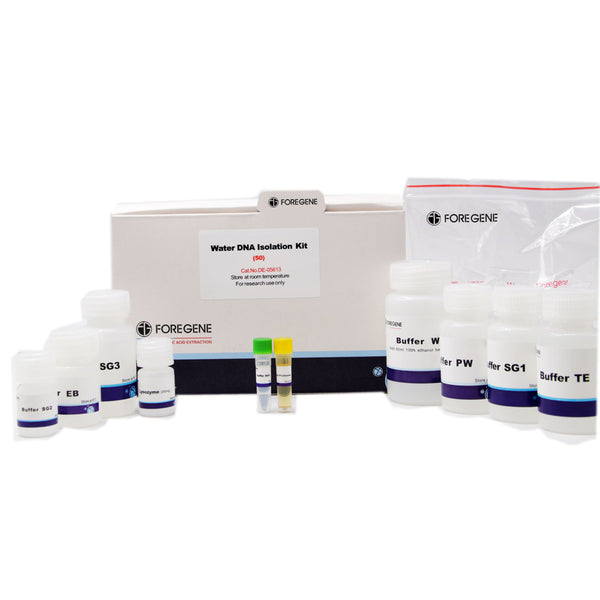
The Water DNA Isolation Kit extracts high-purity genomic DNA from microorganisms in river, lake, pond, aquaculture, tap and seawater samples. Microorganisms are first collected on a 47 mm, 0.22–0.45 µm filter membrane, so the kit handles sample volumes from 10 mL up to 30 L, from clear tap water to turbid pond water. It is suited to environmental DNA (eDNA) studies, water quality monitoring and qPCR detection of specific bacteria.
Water samples carry PCR inhibitors such as humic acid and metal ions that can carry over into the DNA and cause failed or delayed amplification. The kit combines lysozyme and protease lysis with a DNA-Only silica membrane spin column and optimized wash buffers to remove these inhibitors, with no phenol/chloroform extraction and no ethanol or isopropanol precipitation.
The DNA-Only column binds DNA but not RNA, so no RNase needs to be added. All centrifugation steps run at room temperature in a benchtop centrifuge, and 24 samples can be processed in about 40 minutes after filtration. Purified DNA is ready for PCR, qPCR, restriction digestion, Southern blotting and library construction.

| Item | Specifications |
|---|---|
| Product Type | Spin-column DNA extraction kit for water samples |
| Preps | 50 |
| Sample Input | Microorganisms collected on a 47 mm, 0.22–0.45 µm filter membrane |
| Water Volume per Sample | 10 mL to 30 L, depending on turbidity and microbial content |
| Sample Types | River, lake, pond, aquaculture pond, tap water and seawater |
| Column | DNA-Only silica membrane spin column |
| Column Binding Capacity | 80 µg DNA |
| Column Loading Volume | 800 µL |
| Elution Volume | 50–200 µL |
| Processing Time | About 40 minutes for 24 samples, after filtration |
| Throughput | 1–24 samples per run |
| Centrifuge | Benchtop centrifuge at room temperature, up to ~17,000 × g |
| Typical Purity | OD260/280 1.7–1.9 |
| Downstream Applications | PCR, qPCR, restriction digestion, Southern blotting, library construction |
| Water Source | Volume Filtered | DNA Yield | OD260/280 | OD260/230 |
|---|---|---|---|---|
| River water | 400 mL | 1–2 µg | 1.7–1.9 | 1.7–1.9 |
| Pond water | 400 mL | 5–7 µg | 1.7–1.9 | 1.7–1.9 |
| Aquaculture pond water | 20 mL | 1–2 µg | 1.7–1.9 | 1.8–1.9 |
| Tap water | 4,000 mL | 0.05–0.1 µg | ≈1.8 | 1.9–2.0 |
Reference data. Actual yield depends on the water source, turbidity and microbial content.
| Component | DE-05613 (50 Preps) |
|---|---|
| Buffer SG1 | 35 mL |
| Buffer SG2 | 2 mL |
| Buffer SG3 | 35 mL |
| Buffer SG4 | 1.2 mL |
| Buffer PW | 30 mL |
| Buffer WB | 25 mL (add 60 mL absolute ethanol before first use) |
| Buffer EB | 15 mL |
| Buffer TE | 60 mL |
| Protease | 1.8 mL |
| Lysozyme | 250 mg |
| DNA-Only Spin Columns | 50 |
| Instructions for Use | 1 |
Yes. Filter the seawater through a 47 mm, 0.22–0.45 µm membrane according to the protocol, then process the membrane with the kit. The column wash steps remove salts and other inhibitors before elution.
Anywhere from 10 mL to 30 L per sample, depending on turbidity and microbial content. Use smaller volumes for turbid water and larger volumes for clean water such as tap water.
Yes. Inhibitors are removed during column purification, so the DNA can be used directly for PCR and qPCR, for example with the Biofargo Sulfate-Reducing Bacteria Probe qPCR Kit.
No. The DNA-Only spin column does not bind RNA, so no RNase is required.
A filtration setup with 47 mm membranes, a 37 °C shaking incubator, a 65 °C water bath or heat block, a benchtop microcentrifuge, and absolute ethanol.
About 40 minutes for 24 samples after the water has been filtered.
Yield depends on the water source and microbial load. Typical results are 1–2 µg from 400 mL of river water and 5–7 µg from 400 mL of pond water.
When can I expect my order to ship?
Most orders are filled and shipped within 2-3 business days from the time they are received.
Our standard shipping usually take 2-5 days.
We also provide express shippping for time-sensitive deliveries.
Email contact@biofargo.com if you have any requirements.