0 item(s)
View cart
You have no items in your shopping cart.
For laboratory research use only.
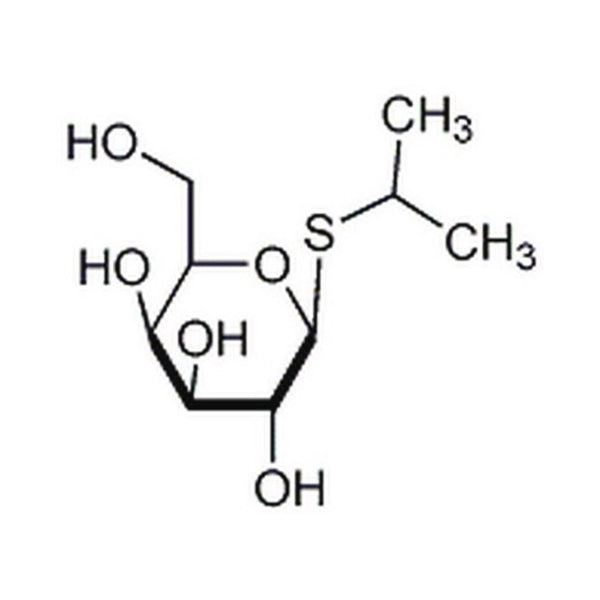
IPTG (Isopropyl β-D-1-thiogalactopyranoside) is a highly pure, non-metabolizable analog of galactose that inactivates the lac repressor to induce the synthesis of β-galactosidase in E. coli. The expression of cloned genes under the control of the lac operon is efficiently induced by IPTG. It also serves as a substrate for thiigalactoside transacetylase and has been reported to induce penicillinase in bacteria.
IPTG is commonly used in molecular cloning procedures that require induction of β-galactosidase. It is most often utilized in conjunction with Biofargo X-Gal for blue/white colony screening, or Magenta-Gal for red/white colony screening of bacterial colonies.
IPTG is an essential reagent for the induction of recombinant proteins. In these expression systems, the protein of interest is encoded downstream of the IPTG-inducible promoter. Upon the addition of IPTG, robust protein expression is induced in the cell culture. The culture can then be lysed, and the expressed protein can be purified through various methods, including His-Tag or GST purification systems.
| Chemical Name | Isopropyl β-D-1-thiogalactopyranoside |
| CAS Number | 367-93-1 |
| Formula | C9H18O5S |
| Molecular Weight | 238.30 g/mol |
| Purity / Quality | ≥99.0% (Dioxane-Free) |
| Grade | Molecular Biology Grade |
| Storage/handling | Store desiccated at -20°C. Protect from light. |
| PubChem CID | 656894 |
Store powder IPTG desiccated at -20°C. Protect from light.
For IPTG stock solution, store in 1 mL aliquots at -20°C for up to 1 year. IPTG is readily dissolved in sterile water.
IPTG, which is similar to the lactose metabolite allolactose, induces the lac operon by binding to the lac repressor. Once IPTG binds to the lac repressor, a conformational change occurs, causing the lac repressor to dissociate from the lac promoter. Once the lac repressor dissociates, RNA polymerase binds to the promoter to initiate expression. It is frequently paired with chromogenic substrates like X-Gal for blue/white colony screening.
Most papers recommend using between 0.1-1.0mM IPTG for expression. However, the optimal amount depends entirely on your target protein. It is best to run an IPTG titration ranging between 0.01-1.0mM and compare expression levels using SDS-PAGE. Keep in mind that excessively high concentrations of IPTG can lead to the formation of inclusion bodies.
IPTG is non-metabolizable, meaning its concentration remains stable throughout the experiment and does not get consumed or depleted by the bacteria, leading to sustained protein induction.
You should typically add IPTG at the mid-log growth phase (OD600 ≈ 0.4–0.6). This ensures that the bacterial cells are healthy, actively dividing, and capable of high-yield protein expression.
No—filter sterilize only. IPTG is heat-sensitive and will degrade under high temperatures, so it should never be autoclaved.
IPTG is highly stable when stored properly as a powder (desiccated at -20°C, protected from light). For liquid stock solutions, repeated freeze-thaw cycles should be avoided to prevent gradual degradation.
The best practice is to prepare single-use aliquots of your IPTG stock solution. Do not refreeze leftovers once thawed to avoid risks of degradation or contamination.
Yes, IPTG can exhibit toxicity at unnecessarily high concentrations or in overly sensitive bacterial strains. If toxicity or cell death occurs, try lowering the IPTG concentration or utilizing auto-induction media alternatives.
Disclaimer
For laboratory research use only.
When can I expect my order to ship?
Most orders are filled and shipped within 2-3 business days from the time they are received.
Our standard shipping usually take 2-5 days.
We also provide express shippping for time-sensitive deliveries.
Email contact@biofargo.com if you have any requirements.