0 item(s)
View cart
You have no items in your shopping cart.
For Research Use Only (RUO)
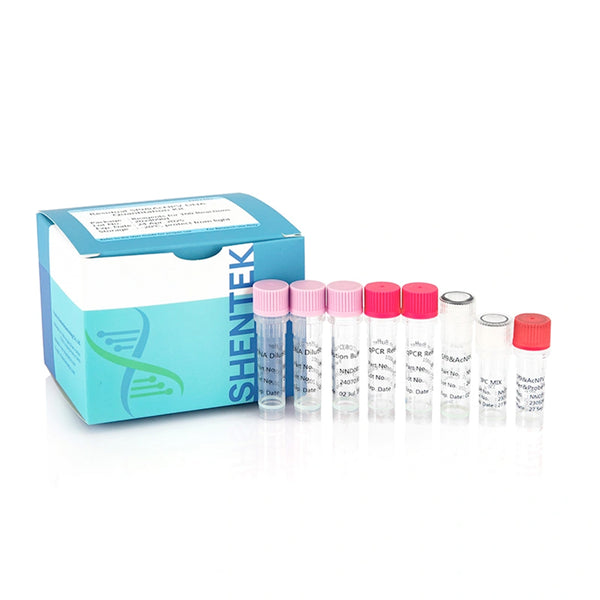
SHENTEK® Residual Sf9&AcNPV DNA Quantitation Kit is designed for quantitative measurement of residual Sf9 and AcNPV host cell DNA in biopharmaceutical materials at different processing stages (in-process to final products). The kit uses a multiplex quantitative PCR (qPCR) assay with internal positive control (IPC) to provide rapid, specific and reliable quantitation down to femtogram-level sensitivity. Supplied reagents include DNA control standards for Sf9 and AcNPV, primer/probe mixes, IPC mix, qPCR reaction buffer and DNA dilution buffer. The kit is compatible with common real-time PCR instruments (e.g., SHENTEK-96S, ABI 7500, Bio-Rad CFX96, FQD-96A). Refer to the SHENTEK® Residual Host Cell DNA Sample Preparation Kit (Product No. 1104191) for extraction guidance.
| Parameter | Details |
|---|---|
| Dynamic range (Sf9) | 300 pg/µL to 0.003 pg/µL (standard curve points: 300, 30, 3, 0.3, 0.03, 0.003 pg/µL) |
| Dynamic range (AcNPV) | 5.14×10^6 to 5.14×10^1 copies/µL (equivalent mass: 20 to 0.0002 pg/µL; standard curve points provided for both copies/µL and pg/µL) |
| Analytical sensitivity | Sensitivity down to femtogram (fg) level implied by standard curve lowest points (Sf9: 0.003 pg/µL = 3 fg/µL) |
| Reaction format & volumes | Reaction total volume 30 µL per well (20 µL qPCR MIX + 10 µL sample). |
| qPCR MIX composition (per reaction) | qPCR Reaction Buffer 15.9 µL; Sf9&AcNPV Primer&Probe MIX 2.8 µL; IPC MIX 1.3 µL (total 20 µL qPCR MIX) |
| Thermal cycling conditions | Activation: 95 °C for 10:00 (1 cycle); Denaturation: 95 °C for 0:15; Annealing/Extension: 60 °C for 1:00 (read fluorescence). 40 cycles. |
| Instrument channels / dyes | Sf9-DNA: FAM; AcNPV-DNA: CY5; IPC: VIC; Passive reference dye: ROX (ABI 7500 example). |
| Standard curve / quantitation settings | Manual Ct with threshold 0.02 for Sf9-DNA, AcNPV-DNA and IPC; use Absolute Quantitation (Standard Curve) analysis. |
| Controls and acceptance criteria | IPC: Ct(sample) should be within ±1.0 Ct of Ct(NCS) — large deviation indicates inhibition. NTC: Ct ≥ 35.00 or undetermined. NCS Ct should be larger than mean Ct of lowest standard and show VIC amplification. |
| Number of reactions per kit | Reagents for 100 reactions (as shipped). |
| Storage stability | Kit components can be stored under appropriate conditions for up to 24 months (see component-specific storage: most components -20 °C; protect qPCR Reaction Buffer from light). |
| Threshold / baseline guidance | Threshold set to 0.02; Automatic baseline recommended when using provided settings. |
• For Research Use Only (RUO). Not for diagnostic use.
• Read Material Safety Data Sheets (MSDS) and follow handling instructions.
• Wear appropriate PPE (eyewear, mask, gloves, protective clothing).
• Work in DNase-free area; use DNase-free, low-retention consumables and tips.
• UV-decontaminate work surfaces and equipment for 30 minutes and disinfect with 75% ethanol before setup.
• Thaw reagents at 2–8 °C or on ice; vortex and spin briefly before use.
• Prepare standards by serial 10-fold dilutions in DDB as instructed; at least five standard concentrations recommended.
• Seal plates well, mix and spin down prior to starting qPCR to avoid evaporation and inconsistent Ct values.
• Monitor IPC: sample Ct-IPC should be within ±1.0 Ct of NCS; significant increase indicates sample inhibition.
• NTC should have Ct ≥ 35.00 or be undetermined; NCS Ct should be larger than mean Ct of lowest standard and show IPC amplification.
• Protect qPCR Reaction Buffer from light.
Research Use Only (RUO) – This product is intended for laboratory research purposes only and not for clinical or regulatory diagnostic use.
Not intended for use in USDA or FDA regulated diagnostic testing or official compliance testing.
When can I expect my order to ship?
Most orders are filled and shipped within 2-3 business days from the time they are received.
Our standard shipping usually take 2-5 days.
We also provide express shippping for time-sensitive deliveries.
Email contact@biofargo.com if you have any requirements.